Why You're Still Hungry After Your Smoothie
You made a healthy smoothie. Fresh fruit, no ice cream, no added junk. You blended something that looks like it belongs on a wellness Instagram account, drank it, and forty-five minutes later your stomach was asking for lunch anyway.
This is not a willpower problem. It is not because smoothies "don't work." It is biology — and the smoothie industry does not want to talk about it clearly because it would complicate the sell.
Here is what is actually happening.
This article is for educational purposes only and is not medical or nutritional advice.
Why a Smoothie Does Not Keep You Full the Same Way Solid Food Does
When you eat solid food, your body starts working before the first bite even reaches your stomach. Chewing triggers a cascade of hormonal signals — GLP-1, cholecystokinin, peptide YY — that tell your brain food is coming, slow your gastric emptying, and start building the feeling of fullness. This process takes time. That is intentional. It is the body's way of preventing you from overeating.
When you drink a smoothie, most of that process gets skipped. There is no chewing. The liquid moves through your stomach faster. The hormonal response is weaker and shorter. Research published in 2026 confirms that solid meals suppress ghrelin — the hormone that makes you hungry — for longer than calorically equivalent liquid meals. Studies on liquid versus solid calories show that people often fail to compensate for liquid calories at subsequent meals, meaning they end up eating more total food across the day even when they "replaced" a meal with a smoothie.
A smoothie consumed in three minutes delivers 350 calories before your body has had time to register that it ate anything.
None of this means smoothies are bad. It means a smoothie that works as a meal replacement has to be built differently than one that works as a snack — and most smoothie recipes are not built that way.
How Much Protein, Fiber, and Fat a Smoothie Needs to Actually Replace a Meal
Three things slow down digestion enough to make a liquid meal work: protein, fat, and fiber. Each does something different.
Protein triggers the satiety hormones most directly. Research from a 2026 PMC study found that liquid meals containing around 30g of protein produce comparable GLP-1 and peptide YY responses to solid protein meals — meaning the liquid disadvantage largely disappears when protein is high enough. Below around 15g, the satiety signal is weak. Below 10g, you are essentially drinking carbohydrates.
Fat slows gastric emptying. It physically keeps food in your stomach longer, which extends the fullness signal. A smoothie with under 5g of fat will clear your stomach relatively quickly. One with 10-15g from avocado, nut butter, or seeds will not.
Fiber adds bulk and feeds the gut bacteria that signal satiety through the gut-brain axis. It also slows glucose absorption, which prevents the blood sugar spike-and-crash that leaves you hungry an hour after a high-fruit smoothie.
The minimum threshold for a smoothie to function as a meal replacement, based on the research, is roughly 15-20g protein, 8-10g fiber, and at least 8-10g fat. Most fruit-forward smoothie recipes do not hit any of those three numbers.
Smoothie Meal Replacement Comparison: Two Real Builds With Actual Numbers
Here is the problem made visible with real data from PureFyul's Smoothie Builder for a Man 19-30.
The smoothie that looks healthy but will not keep you full: Orange 150g + banana 120g + mango 150g + oat milk 150ml + honey 8g
- Calories: 356 kcal
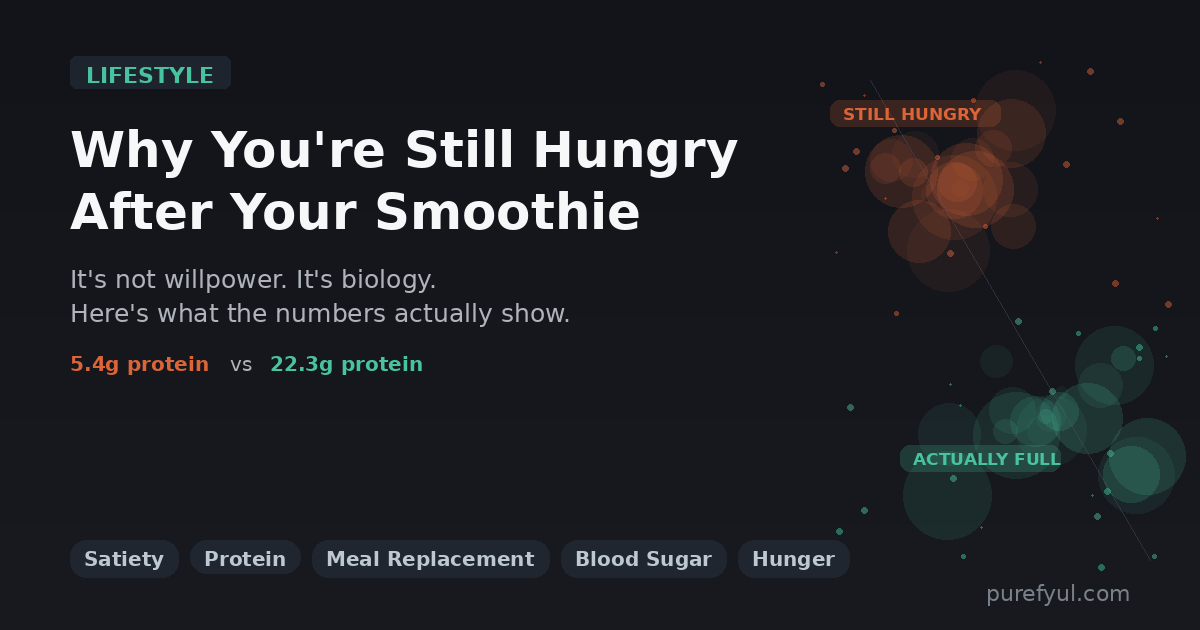
- Protein: 5.4g
- Fiber: 10.3g
- Sugar: 58.3g
- Fat: 3.3g
This smoothie is not junk food. It has real fruit, no artificial anything, decent fiber. It also has 58.3g of sugar — almost entirely from three fruits plus honey — and 5.4g of protein with 3.3g of fat. That combination means fast digestion, a blood sugar spike, and hunger returning before your next meal is due. The low protein means your satiety hormones barely respond. The low fat means nothing is slowing the process down.
The smoothie that will actually replace a meal: Cottage cheese 110g + banana 120g + chia seeds 12g + oats 40g
- Calories: 429 kcal
- Protein: 22.3g
- Fiber: 11.6g
- Sugar: 17.0g
- Fat: 11.3g
The calorie difference is 73 kcal. That is not significant. What is significant is everything else. Protein is four times higher. Sugar is two-thirds lower despite still containing banana. Fat is three times higher. Fiber is meaningfully higher. This smoothie will trigger a real hormonal satiety response, slow digestion, and keep you full — not because of magic, but because of what is in it.
The first smoothie looks more like a wellness drink. The second one does the job. You can build and compare both in PureFyul's Smoothie Builder and see the numbers update in real time as you add each ingredient.
Does Drinking Speed Affect How Full a Smoothie Makes You?
Yes — and almost nobody in smoothie content mentions this.
A solid meal takes 20-30 minutes to eat. That is how long it takes for the hormonal fullness signals to reach your brain. If you drink a 400-calorie smoothie in three minutes, you have consumed your meal before your body has had any time to register it. The hormonal cascade that creates fullness needs time to develop. You are outrunning it.
Slowing down helps. Some people pour thick smoothies into a bowl and eat them with a spoon, which forces slower consumption and adds some of the chewing response back in. This is not a trick — the evidence on mastication and satiety is real. It is also not necessary for everyone. But if you are building a nutritionally solid smoothie and still finding yourself hungry, drinking speed is worth looking at before you change anything else.
How to Know if Your Smoothie Is a Meal or a Snack
A smoothie with under 10g of protein and over 40g of sugar is a snack, not a meal — regardless of what the recipe calls it. That is not a judgment. Snacks have a place. The problem is when people use a snack-level smoothie to replace a meal and then blame themselves for being hungry two hours later.
Before you blend, check three numbers: protein, sugar, and fat. If protein is under 10g, add cottage cheese, Greek yogurt, or oats. If sugar is over 40g, reduce the fruit or swap honey for something that does not spike glucose. If fat is under 5g, add seeds or a small amount of avocado or nut butter.
You can check all of this in PureFyul's Smoothie Builder before you make anything. Build your usual recipe, look at the nutrition panel, and decide from there whether it is doing the job you are asking it to do.
For smoothies built around specific health goals, the Weight Balance goal page lists ingredients that support satiety and blood sugar management.
Related Reading
- Why Two Cottage Cheese Smoothie Recipes Never Have the Same Protein Number
- Pre-Workout vs Post-Workout Smoothie Guide
- How to Build a Smoothie Around Your Health Goal
- Smoothies for Gut Health: The Difference Between Prebiotic and Probiotic Ingredients
- Skin Glow Smoothies: Which Ingredients Actually Have Evidence Behind Them
- Iron-Rich Smoothie for Teenage Girls
- Building a Nutrient-Smart Pregnancy Smoothie: What to Look For
- Kid-Friendly Smoothie Portions Guide