The Problem With "1 Cup" Smoothie Recipes
Search for "smoothie for kids" and you'll find hundreds of recipes. Almost all of them share the same problem: they tell you to use "1 cup of milk" and "½ cup of berries" without telling you whose cup, for what age, or how many grams that actually is.
A cup in the U.S. is 240 ml. A cup in Australia is 250 ml. A cup in Japan is 200 ml. A "heaping cup" could be anything. And none of these account for whether the smoothie is for a 4-year-old or a 14-year-old.
For a child with food allergies, this vagueness is worse than unhelpful — it's risky. If a recipe calls for "a scoop of protein powder" and your child is allergic to whey, soy, and tree nuts, you need to know exactly what goes in and exactly how much.
Why Age-Specific Portions Matter
A 5-year-old and a 13-year-old have very different nutritional needs. A smoothie that's a reasonable breakfast for a teenager could contain twice the sugar a preschooler should have in one sitting.
Consider spinach. It's a common smoothie ingredient that most parents assume is harmless in any amount. But spinach contains oxalates, and the appropriate portion differs significantly between a Child 4–6 and a Boy 14–18. The same applies to oats, nut butters, seeds, and even bananas — the right amount depends on the child's age, not on a generic recipe.
Most recipe blogs can't solve this because they publish one static recipe. They might add a note like "adjust for smaller children," but they don't tell you what that adjustment actually looks like in grams.
The Allergen Problem Is Worse Than You Think
About 1 in 13 children in the U.S. has a food allergy. Around 40% of those children are allergic to more than one food. That means a recipe labeled "dairy-free" might still contain tree nuts, soy, or egg-based protein powder.
Here's what typically goes wrong:
Hidden allergens in "healthy" ingredients. Many protein powders contain whey (dairy), soy lecithin, or are processed in facilities that handle tree nuts. Granola toppings frequently contain wheat, soy, and tree nuts. Even oat milk may be cross-contaminated with gluten unless it's certified gluten-free.
Vague ingredient names. "Milk alternative" could mean almond milk (tree nut), soy milk (soy), oat milk (potential gluten cross-contact), or coconut milk (classified as tree nut by the FDA). A parent managing multiple allergies needs specificity, not suggestions.
No real-time checking. A recipe blog can't warn you mid-build that the ingredient you just added conflicts with your child's allergen profile. You discover the problem at the grocery store or worse, after your child drinks it.
What "Exact Portions" Actually Looks Like
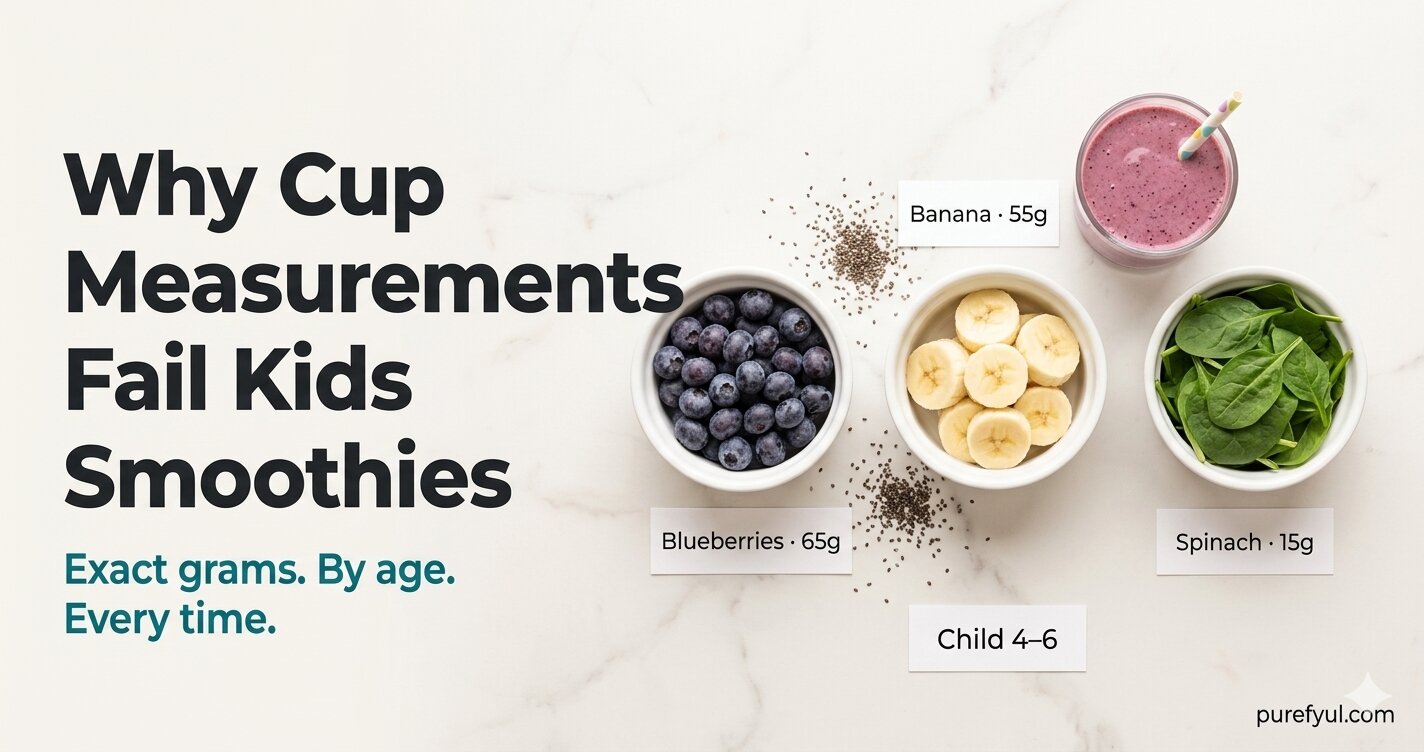
Instead of "½ cup of banana," an age-appropriate smoothie for a Child 4–6 might specify 60g of banana. For a Boy 9–13, it might be 100g. The difference matters because it changes the sugar content, the calorie count, and how the smoothie fits into the rest of your child's daily intake.
This is what PureFyul does differently from recipe blogs:
You select who the smoothie is for. Not "kids" as a generic category — a specific audience like Child 4–6, Girl 9–13, or Boy 14–18. The portions adjust based on that selection.
Every ingredient shows exact grams. Not cups, not tablespoons, not "a handful." Grams you can measure on a kitchen scale. Repeatable, precise, no guessing.
Allergens are flagged during the build. You don't discover an allergen conflict after you've already blended. The tool checks as you add each ingredient.
Nutrition totals update in real time. As you add spinach, then oats, then banana, you see the cumulative calories, protein, carbs, fat, fiber, sugar, and sodium. You know before you blend whether this smoothie is appropriate for your child.
Fruit limits are enforced. PureFyul caps fresh fruit at 3 per smoothie and dried fruit at 1. This prevents the common mistake of building a "healthy" smoothie that's actually a sugar bomb with five fruits and no protein.
Building a Smoothie for a Child With Multiple Allergies
Let's say your child is 6 years old with dairy, peanut, and soy allergies. Here's how a parent would approach this in PureFyul versus a recipe blog:
On a recipe blog: You search "dairy-free smoothie for kids." You find a recipe that uses almond milk, banana, spinach, and whey protein. You can't use the whey protein (dairy), so you substitute — but with what? The blog doesn't tell you what's safe for a child who also can't have soy or peanuts, or how much protein powder is appropriate for a 6-year-old. You're on your own.
On PureFyul: You open the smoothie builder, select "Child 4–6" as your audience, pick a health goal like "Immune Support," and start adding ingredients. You choose oat milk instead of almond milk. You add banana — the tool shows you the exact gram portion for a 4–6 year old. You add spinach — exact grams, plus allergen check confirms it's clear. You add hemp seeds for protein — exact grams, allergen check confirms no conflicts with dairy, peanut, or soy. You build the whole smoothie with live nutrition totals and zero guesswork.
What About Preset Smoothies?
Not every parent wants to build from scratch. PureFyul includes preset smoothies — pre-built combinations that are ready to go. When you select an audience (like Child 7–8), the presets automatically adjust portions for that age group.
If a preset contains an ingredient that isn't appropriate for the selected audience, the tool removes it and tells you. No silent failures, no assumptions.
This is especially useful for busy mornings. Pick a preset, confirm the portions look right for your child, check the allergen flags, and blend.
The "Start Simple" Approach for Allergy Families
If your child was recently diagnosed with food allergies, you don't need 50 recipes. You need 3 safe smoothies you can rotate.
Here's how to find them:
- Open the PureFyul smoothie builder
- Select your child's age group
- Choose a health goal that matters to your family
- Start with 3–4 ingredients you already know are safe
- Check the allergen flags and nutrition totals
- Save the combination and repeat it
Once you have 3 reliable smoothies, you can start experimenting — swapping one ingredient at a time, checking the allergen flags each time, and building your family's safe list gradually.
When to Use Ingredient Analysis Instead
Sometimes you don't need a full smoothie — you just want to check one ingredient. PureFyul's Ingredient Analysis tab lets you:
- Search any single ingredient
- See its full nutrition breakdown (macros and key micronutrients)
- Check allergen flags
- See which health goals it supports
This is useful before you introduce a new ingredient to your child's diet. Check the allergen status first, see the nutrition profile, and then decide whether to add it to your next smoothie build.
A Note on Medical Advice
PureFyul provides educational nutrition and allergen information. It is not a substitute for medical advice. Every child's allergies are different — some are mild sensitivities, others are life-threatening anaphylaxis risks.
Always confirm new ingredients with your child's allergist. Always read the full label on any packaged ingredient, including "may contain" warnings. And if your child has a reaction, seek medical help immediately.
The goal of this tool is to reduce guesswork and make the safe choices easier to find — not to replace the professionals who manage your child's care.
Try It
The PureFyul smoothie builder is free and requires no signup. Select your child's age, pick ingredients, and see exact portions, allergen checks, and nutrition totals before you blend.
If this guide was useful, share it with another allergy parent. The more families who know about age-specific portions and real allergen checking, the fewer kids end up drinking smoothies that were never built for them.