This one is for the parents who are worried and the teenage girls who are always tired.
If you have a daughter between 13 and 18 years old and she often complains about feeling exhausted, having trouble concentrating at school, or just looking pale and drained — there is a good chance iron is the problem. Not always, but more often than most people realise.
The Numbers Are Alarming
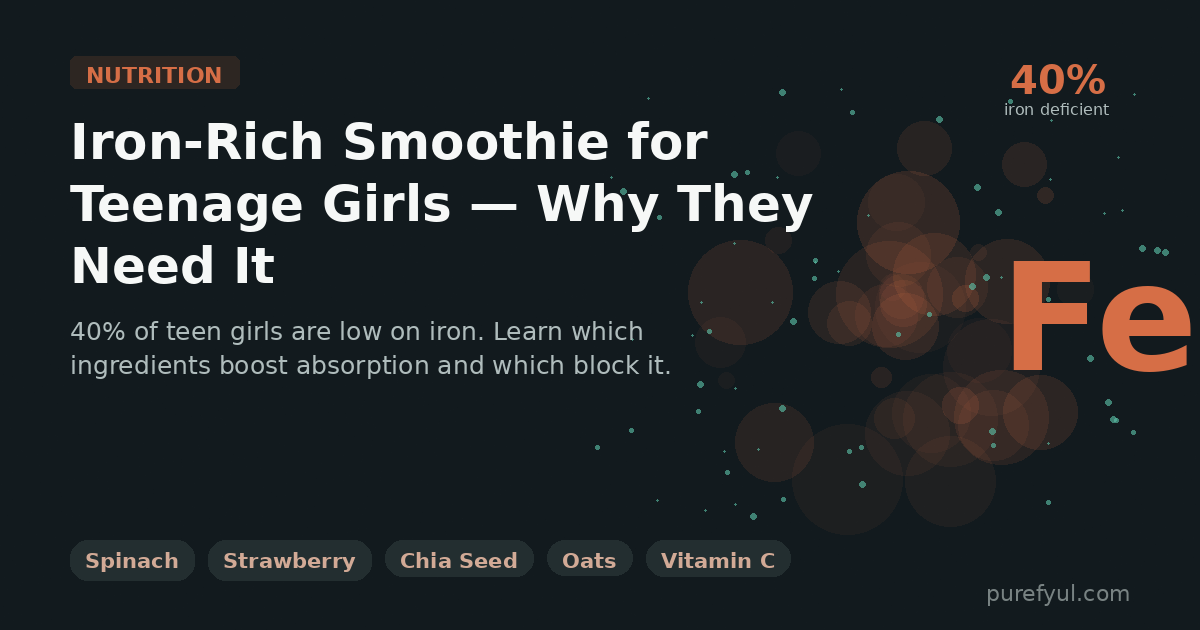
A study from Lund University in Sweden found that 4 out of 10 teenage girls had an iron deficiency. A separate study from the United States looked at nearly 3,500 girls aged 12 to 21 and found the same thing — close to 40% had low iron levels. This is not a small number. This is almost half.
The reason is straightforward. Once a girl starts her period, she loses iron through menstrual blood every month. Her body is also growing rapidly during these years, which means it needs more iron than before. The daily recommended intake jumps from 8mg to 15mg after menstruation begins. Most girls are simply not eating enough iron-rich food to keep up with both demands at the same time.
A smoothie will not fix severe iron deficiency — that needs a doctor and possibly supplements. But for everyday iron intake, a well-built smoothie can contribute 4 to 7mg of iron in a single glass. That is a meaningful portion of the daily 15mg goal. And it takes less than five minutes to make.
Here is how to do it properly.
The One Rule That Changes Everything — Vitamin C
Before we talk about ingredients, there is one thing you need to understand about plant-based iron.
There are two types of iron in food. Heme iron comes from meat and fish. Your body absorbs about 25% of it. Non-heme iron comes from plants — spinach, oats, chia seeds, beans. Your body only absorbs about 5% of it. That is a big difference.
But here is the trick. When you eat non-heme iron together with vitamin C, the absorption rate goes up significantly. The vitamin C converts the iron into a form that your gut can absorb much more easily.
This is why every ingredient combination in this post pairs an iron-rich food with a vitamin C source. It is not random. It is the single most important thing you can do to get more iron from a smoothie.
What to Put in an Iron-Rich Smoothie
Let me walk through the ingredients one by one, starting with the iron sources and then the vitamin C boosters.
Spinach — the foundation. Spinach is the best smoothie ingredient for iron. A 100g serving has about 2.7mg of iron. It blends smooth, it has almost no taste when mixed with fruit, and most teenagers will not even know it is in there. If your daughter says she does not like spinach, tell her to try it in a smoothie first. The banana and strawberry completely hide it.
Oats — quiet iron contributor. Oats add about 2mg of iron per 40g serving. They also make the smoothie thicker and more filling, which is useful if this is a breakfast smoothie. Oats have the bonus of providing B-vitamins that help with energy — something a tired teenager actually needs.
Chia seed — small but powerful. 20g of chia seeds add roughly 1.5 to 2mg of iron. They also bring omega-3 fatty acids and fiber. Chia seeds absorb liquid and create a gel-like texture, which makes the smoothie more substantial without adding sugar.
Flaxseed — another seed option. Similar to chia in iron content. 10g of ground flaxseed gives about 1mg of iron plus omega-3s. You can use either chia or flax, or a bit of both. Ground flaxseed blends better than whole.
Kale — if she will accept it. Kale has slightly more iron than spinach per gram, but it has a stronger taste. For a teenage girl who is new to green smoothies, start with spinach. Once she is used to it, you can mix in 30 to 40g of kale for an extra iron boost.
Now the vitamin C partners — these are not optional.
Strawberry — the best pairing. Strawberries are high in vitamin C and they taste good. This is the ingredient that makes the smoothie feel like a treat instead of medicine. 150g of strawberries gives about 85mg of vitamin C, which is more than the daily requirement. That vitamin C dramatically improves how much iron your body pulls from the spinach and oats.
Banana — for texture and potassium. Banana does not have significant iron or vitamin C, but it makes the smoothie creamy, adds natural sweetness, and provides potassium. It is the ingredient that makes teenagers actually want to drink the smoothie again tomorrow. Frozen banana works even better — it makes the smoothie cold and thick, almost like a milkshake.
Blueberries — antioxidant bonus. Blueberries add some vitamin C, plenty of antioxidants, and a colour that looks better than pure green. Mixing blueberries with spinach turns the smoothie purple instead of green — which can help if your daughter is put off by a bright green drink.
What to Avoid — This Is Important
Most people do not know this, but certain things block iron absorption. If you put these in an iron-rich smoothie, you are working against yourself.
Dairy milk and yogurt. Calcium competes with iron for absorption. If you use regular milk or greek yogurt as the base of an iron-focused smoothie, the calcium will reduce how much iron your body absorbs. This does not mean dairy is bad — it just means do not combine it with your high-iron meal. Use water, orange juice, or almond milk instead. Almond milk is very low in calcium compared to dairy milk.
Tea or coffee. Some teenagers drink iced tea or coffee. The tannins in tea and the polyphenols in coffee can reduce iron absorption by up to 60%. Do not add these to a smoothie and do not drink them right after an iron-rich smoothie. Wait at least an hour.
Too much fiber at once. Chia seeds and oats both have fiber, which is generally good. But an extreme amount of fiber in one sitting can bind to minerals including iron and reduce absorption. Keep chia to 12 to 20g and oats to 25 to 30g. You do not need to go overboard.
A Simple Recipe to Start
If this is your first time making an iron-rich smoothie for your daughter, start simple.
Put 80g of spinach, 120g of frozen banana, 100g of strawberries, 12g of chia seed, 25g of oats, and 240ml of water or almond milk into a blender. Blend until smooth.
That is it. No protein powder. No weird supplements. Just whole food with exact portions.
This combination gives you roughly 4 to 5mg of iron — about a third of the daily requirement — paired with plenty of vitamin C to help absorb it. If she likes the taste, you can gradually increase the spinach to 100g or add 10g of flaxseed next time.
How to Check the Numbers
Here is where most recipes fall short. They tell you what to put in but they do not show you the actual nutrition totals. How much iron is really in the smoothie? How much sugar? How much vitamin C?
The PureFyul smoothie builder shows you all of this in real time. As you add each ingredient, you see the exact iron, vitamin C, sugar, fiber, and calorie totals update live. You can adjust portion sizes and see how the numbers change.
This is especially useful for iron because the difference between 30g of spinach and 80g of spinach is significant. With a recipe blog, you just follow instructions blindly. With PureFyul, you see whether your smoothie actually meets the iron goal you set.
You can explore more iron-rich ingredients in the Iron Support goal page or browse the full Ingredient Directory to check any ingredient's nutrition and allergen information before adding it.
Why This Matters More Than You Think
Iron deficiency in teenage girls is not just about feeling tired. Research shows it affects concentration, memory, mood, and even sleep quality. A girl who is struggling at school might not have a motivation problem — she might have an iron problem. A girl who is always irritable or anxious might not be going through a phase — her ferritin levels might be low.
The tricky part is that iron deficiency can exist without full-blown anemia. A girl can have low iron stores and still have a normal blood count. This means she feels the symptoms — the fatigue, the brain fog, the weakness — but a basic blood test might not catch it unless the doctor specifically checks ferritin levels.
If your daughter has heavy periods, is vegetarian or vegan, is a competitive athlete, or simply does not eat much red meat — she is at higher risk. A Lund University study found that girls who had heavy periods and followed a meat-restricted diet were over 13 times more likely to be iron deficient compared to girls with normal periods who ate meat regularly.
That number is worth sitting with for a moment. Thirteen times.
This Is Not a Replacement for Medical Advice
I want to be clear about something. A smoothie is food, not treatment. If you suspect your daughter has an iron deficiency, take her to a doctor and get her ferritin levels checked. If her levels are very low, she may need iron supplements that provide far more iron than any smoothie can.
What a smoothie does is help with everyday intake. It helps her reach that 15mg daily target through food so that her iron stores do not keep dropping month after month. Think of it as prevention, not cure.
PureFyul provides nutrition data to help you make informed choices. It does not replace a doctor, a dietitian, or a blood test.
Related Reading
If you are making smoothies for younger children, we have a separate guide that covers age-appropriate portions and allergen safety: Kid-Friendly Smoothie Portions Guide.
If you want to understand how to pick smoothie ingredients based on different health goals — not just iron but also immune support, blood sugar, skin health, and more — read: How to Build a Smoothie Around Your Health Goal.
And if your daughter is also into fitness, the pre-workout and post-workout smoothie needs are different: Pre-Workout vs Post-Workout Smoothie Guide.
Try It
The PureFyul smoothie builder is free. No signup needed. Add the ingredients, check the iron and vitamin C totals, and adjust until it looks right. You will know exactly what is going into the glass before you blend.
If this post helped you, send it to another parent. Nearly half of teenage girls are not getting enough iron, and most of them do not even know it.