If you are someone who works out regularly, you probably already drink smoothies. But here is a question most people never think about — are you drinking the same smoothie before and after your workout?
If the answer is yes, you are making a common mistake.
What your body needs before exercise is not the same as what it needs after. Before a workout, your body needs fuel to perform. After a workout, your body needs material to repair. The ingredients are different. The ratios are different. Even the timing is different.
Let me explain this simply, with the exact ingredients and the reasoning behind each one.
Why Pre-Workout and Post-Workout Are Not the Same
Think of it this way. Before a workout, your body is like a car about to go on a long drive. It needs fuel — carbohydrates that give energy and a small amount of fat to keep things steady. You do not want heavy food sitting in your stomach. You want something light that converts to energy quickly.
After a workout, your body is like that same car after the drive. The engine is hot, the fuel is used up, and some parts need repair. Now your body needs protein to rebuild the muscles that got broken down during exercise, plus some carbohydrates to refill the energy that was used.
If you put heavy protein and fat before a workout, you will feel sluggish. If you only put fruit and carbs after a workout, your muscles will not recover properly.
This is why one smoothie recipe does not work for both situations.
What Goes in a Pre-Workout Smoothie
The goal before a workout is simple — give your body quick energy without making your stomach heavy. The ideal ratio is roughly 3 to 4 parts carbohydrates for every 1 part protein. Fat should be kept low because fat slows down digestion, and you do not want that when you are about to exercise.
Best ingredients for pre-workout:
Banana is the number one choice. It gives you fast-digesting carbohydrates, natural sugar for quick energy, and potassium which helps prevent muscle cramps. Almost every fitness expert recommends banana before exercise, and there is a good reason for that.
Oats are excellent because they give you slow-releasing energy. While banana gives you a quick boost, oats keep the energy going throughout your workout. They also have B-vitamins that help your body convert food into energy.
Spinach is something most people do not think about for pre-workout, but it is very useful. Spinach has iron, which helps carry oxygen to your muscles. More oxygen means better performance and less fatigue. The taste is mild enough that you will not even notice it in the smoothie.
Blueberries or strawberry add natural sweetness and antioxidants. The antioxidants help reduce the oxidative stress that happens during intense exercise.
For liquid, use water, coconut water, or almond milk. Avoid heavy milk or cream before a workout.
What to avoid before workout: Heavy fats like large amounts of peanut butter or avocado. A little bit is okay, but too much fat will sit in your stomach and slow you down. Also avoid too much fiber — a huge dose of chia seed before exercise can cause bloating.
When to drink it: About 30 to 60 minutes before your workout. This gives your body enough time to start digesting and converting the food into energy.
Explore this goal: Energy & Stamina on PureFyul
What Goes in a Post-Workout Smoothie
After a workout, the priority completely changes. Now your body needs protein to repair muscle tissue and carbohydrates to refill the glycogen stores that were used during exercise. This is what fitness people call the "recovery window" — the 30 to 60 minutes after exercise when your body absorbs nutrients most efficiently.
The ideal ratio flips. Now you want roughly equal parts protein and carbohydrates, and healthy fats are welcome because they help with absorption and reduce inflammation.
Best ingredients for post-workout:
Greek yogurt is one of the best post-workout ingredients. A single serving gives you around 15 to 20 grams of protein, plus calcium for bone health. It also makes the smoothie thick and creamy, which is satisfying after a hard workout.
Peanut butter adds protein, healthy fats, and calories. After a workout, your body actually needs these calories. Peanut butter also has magnesium, which helps with muscle relaxation and recovery.
Banana works here too, but for a different reason than pre-workout. After exercise, banana helps replenish glycogen stores and the potassium helps with muscle recovery. It also adds natural sweetness so you do not need any added sugar.
Oats are again useful because they provide complex carbohydrates that release slowly, keeping your energy stable during recovery instead of crashing.
Flaxseed or chia seed are perfect for post-workout. They add omega-3 fatty acids which help reduce the inflammation that exercise causes in your muscles. This is the time to add them — not before the workout.
Spinach again for the iron and folate, which support recovery and help reduce fatigue after exercise.
When to drink it: Within 30 to 60 minutes after your workout. The sooner the better, but do not stress about exact timing. The important thing is to get protein and carbs into your body within that general window.
Explore this goal: Muscle Recovery on PureFyul
A Simple Side-by-Side Comparison
Here is the difference laid out clearly:
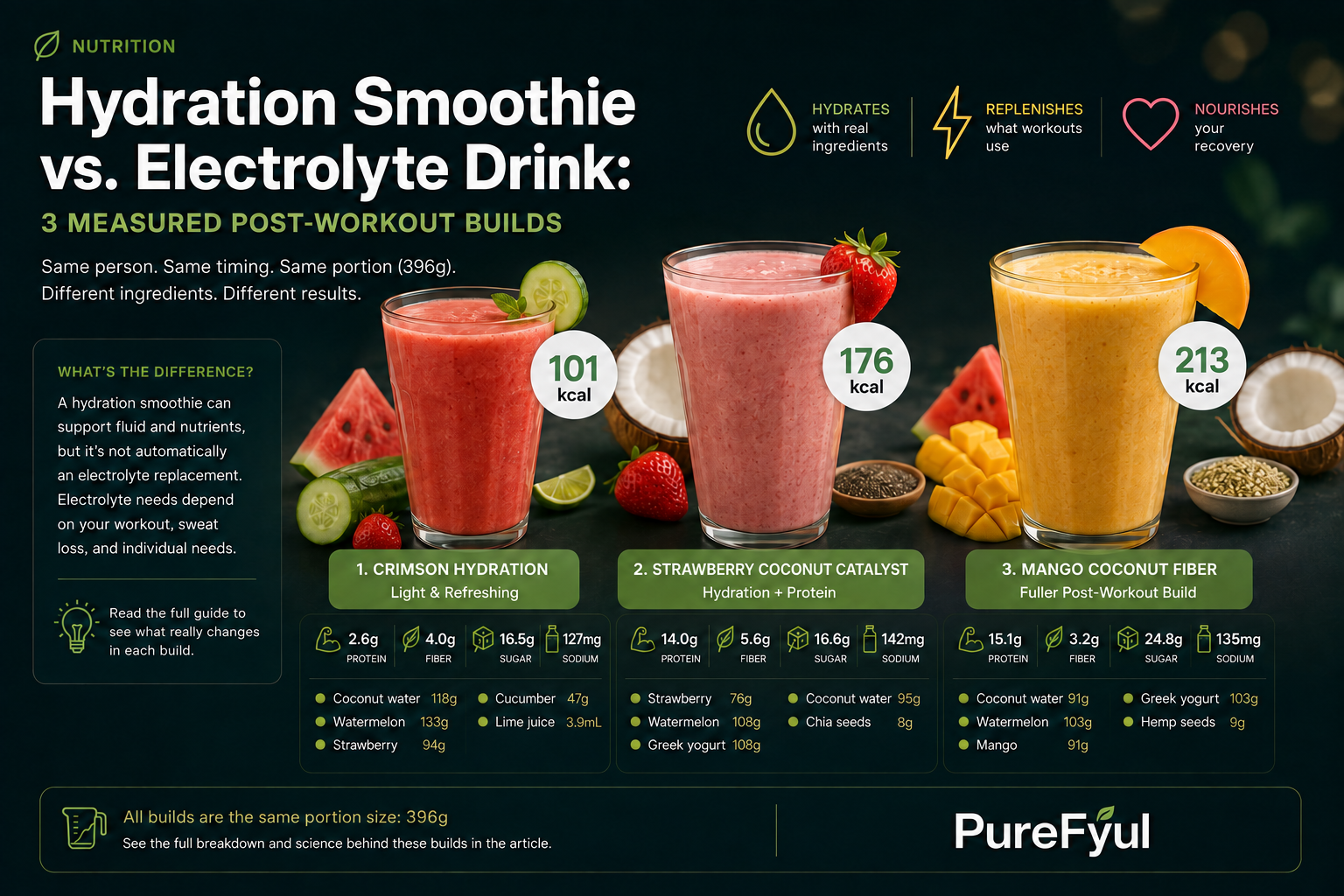
Pre-workout smoothie focuses on quick energy. More carbohydrates, less protein, very little fat. Keep it light. Think banana, oats, berries, spinach, and water or almond milk.
Post-workout smoothie focuses on recovery. More protein, moderate carbohydrates, healthy fats are welcome. Make it substantial. Think greek yogurt, peanut butter, banana, oats, flaxseed, and milk.
The ingredients overlap — banana and oats appear in both. But the proportions and the supporting ingredients change completely.
The Problem With Most Workout Smoothie Recipes Online
If you search for "pre-workout smoothie" or "post-workout smoothie" online, you will find dozens of recipes. Most of them list ingredients without telling you the actual nutrition numbers. They will say "add a scoop of protein powder" but not tell you how much total protein is in the finished smoothie.
This is a problem because workout nutrition is about numbers. If your post-workout smoothie only has 8 grams of protein, that is not enough for muscle recovery. If your pre-workout smoothie has 30 grams of fat, that is too much and it will slow you down.
You need to see the numbers before you blend, not after.
How PureFyul Helps With This
This is exactly what the PureFyul smoothie builder is built for. When you add each ingredient, you see the total calories, protein, carbohydrates, fat, fiber, and sugar updating in real time.
So when you are building a pre-workout smoothie, you can check — is my carb-to-protein ratio close to 4:1? Is the fat content low enough? If not, you adjust the ingredients right there before wasting anything.
For post-workout, you can verify — am I getting at least 15 to 20 grams of protein? Are there enough carbs to replenish glycogen? Is there a source of omega-3 for inflammation?
No guessing. No hoping the recipe you copied from somewhere is actually balanced. You see everything before you blend.
The tool also flags allergens automatically. If you have a dairy allergy, it will tell you the moment you add greek yogurt. If you are allergic to nuts, it will flag the peanut butter. This is important because many workout smoothie recipes online do not mention allergens at all.
You can also browse the Ingredient Directory to check any ingredient before adding it. Want to know exactly how much protein is in greek yogurt versus peanut butter? Check it there.
Common Mistakes People Make
Mistake 1 — Too much fruit in the post-workout smoothie. After exercise, your body needs protein, not just sugar. A smoothie with banana, mango, pineapple, and honey tastes great but it gives you mostly sugar and very little protein. PureFyul caps fruit at 3 per smoothie to prevent this exact problem.
Mistake 2 — Heavy fats before workout. A tablespoon of peanut butter is fine. Three tablespoons plus avocado plus coconut oil will sit in your stomach like a brick. Save the fats for after.
Mistake 3 — Skipping the post-workout smoothie entirely. Many people work out and then just drink water. Your muscles cannot recover properly without protein. Even a simple smoothie with greek yogurt, banana, and oats is far better than nothing.
Mistake 4 — Using the same smoothie for both. Now you know why this does not work. The purpose is different, so the recipe should be different.
What If You Are a Beginner?
If you are just starting out with fitness and this feels like too much information, keep it simple.
Before workout: Blend one banana with a handful of oats and water. That is it. Quick energy, light on the stomach, takes two minutes to make.
After workout: Blend greek yogurt, one banana, a spoon of peanut butter, and milk. That gives you protein, carbs, and healthy fat for recovery.
Start there. As you learn more about your body and your goals, you can add ingredients like spinach for iron, flaxseed for omega-3, or blueberries for antioxidants. Use PureFyul to check the nutrition each time so you know exactly what you are putting in.
If you want to understand how to pick ingredients based on specific health goals — not just fitness but things like immune support, blood sugar management, or skin health — we have written a detailed guide on that. You can read it here: How to Build a Smoothie Around Your Health Goal.
And if you are making smoothies for your children, portion sizes and allergen safety are different for kids. We have covered that too: Kid-Friendly Smoothie Portions Guide.
A Note on Health
This article is for educational purposes only. It is not medical advice. If you have any health condition, food allergy, or dietary restriction, please talk to your doctor or a registered dietitian before making changes to your diet.
PureFyul gives you nutrition data so you can make informed choices. It does not replace professional medical guidance.
Try It Now
The PureFyul smoothie builder is free and does not require any signup. Pick your goal, add your ingredients, and see the full nutrition breakdown before you blend.
If this article helped you, share it with a friend who drinks the same smoothie before and after every workout. They need to read this.