Why Two Cottage Cheese Smoothie Recipes Never Have the Same Protein Number
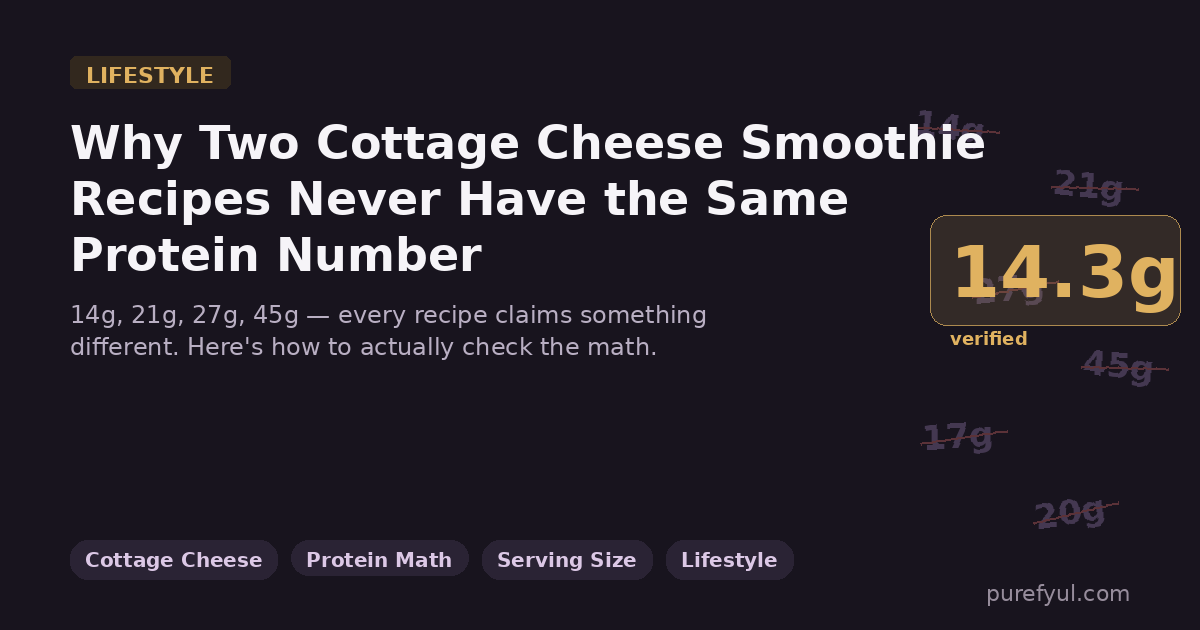
Cottage cheese is having a real moment in smoothies right now, and if you search around for a recipe, you'll run into a strange problem fast: nobody agrees on how much protein you're actually getting. One blog says 14 grams per serving. Another says 21. A third claims 27. One particularly enthusiastic recipe claims 45 grams in a single glass. They all use roughly the same ingredients: cottage cheese, fruit, sometimes milk. So what's going on?
None of these numbers are necessarily wrong. They're just answering a different question than the headline suggests, and almost no recipe explains which question it's actually answering.
This article is for educational purposes only and is not medical or nutrition advice.
"Per Serving" Means Whatever the Recipe Author Decided It Means
There's no universal definition of a smoothie serving. When a recipe says "Serving: 1 smoothie, Protein: 27g," that serving could be the entire blended batch poured into one big glass, or it could be half a batch split into two smaller glasses, with the other half meant for later or for someone else. Some recipes fold in a scoop of protein powder or a couple of eggs and still call the result "1 smoothie," without flagging that the protein number now includes ingredients well beyond cottage cheese and fruit.
None of this is dishonest. It's just a detail that gets buried in the recipe card, usually below the fold, in a tiny "nutrition facts" disclaimer that most people skim past on their way to the ingredients list.
The practical effect: a 14-gram recipe and a 45-gram recipe might both be "accurate," while being almost impossible to compare to each other, because they were never describing the same size glass in the first place.
Three Things to Actually Check Before You Trust a Protein Number
If you want to evaluate any cottage cheese smoothie recipe, whether it's from this article or somewhere else, three questions will tell you almost everything:
How many servings does the full recipe make? If a recipe lists ¾ cup cottage cheese, a cup of fruit, and milk, and calls it "1 serving," that's a much bigger glass than a recipe using half a cup of cottage cheese split into two servings. Scroll down to the ingredient list and do quick mental math on the total volume before you look at the protein number.
What's actually in it besides cottage cheese? Protein powder, eggs, Greek yogurt, and nut butter are common smoothie add-ins that significantly boost protein on their own. A recipe with 45 grams of protein is very likely using more than just cottage cheese and fruit. That's not a problem, but it does mean the headline number isn't really about cottage cheese anymore.
Is the gram amount of cottage cheese stated, or just "a cup" or "a scoop"? Cottage cheese brands vary in protein density, and "a cup" can mean different things depending on how packed it is. A recipe that states an exact gram amount is giving you something you can actually verify; one that says "a generous scoop" is asking you to trust its math without the ability to check it.
What Cottage Cheese Actually Contributes, In Real Numbers
To ground this in something concrete rather than abstract advice, here's real nutrition data for plain cottage cheese on its own: per 110g (about half a cup), cottage cheese provides 108 kcal and 12.1g of protein, along with 400mg of sodium, 2.2g of sugar, 3.3g of carbs, 4.4g of fat, and notable amounts of B12, calcium, and phosphorus.
That sodium figure is worth pausing on, because it's almost never mentioned in cottage cheese smoothie content. 400mg from cottage cheese alone, before anything else goes in the blender, is a meaningful slice of a day's sodium intake. If you're someone watching sodium and you're about to make cottage cheese smoothies a daily habit rather than an occasional one, that's worth factoring in alongside the protein excitement.
A Worked Example, Built From Real Numbers
Here's what one real combination looks like when every ingredient is measured in grams rather than cups or scoops: 110g cottage cheese, 120g banana, and 120g strawberry, blended together for one adult serving (350g total).
That combination comes out to 253 kcal, 14.3g protein, 5.5g fiber, 22.5g sugar, 40.5g carbs, 5.1g fat, and 403mg sodium. Most of the protein here comes from the cottage cheese; most of the sugar and carbs come from the banana and strawberry. Because this was built as a single serving rather than a larger batch, the full recipe total and the "one portion" amount are the same number, 350g, with nothing hidden or divided behind the scenes.
Compare that 14.3g to the 45g claim mentioned earlier, and the gap makes a lot more sense once you know one recipe is cottage cheese and fruit alone, and the other almost certainly isn't.
The Real Takeaway
A protein number on its own tells you almost nothing useful. A protein number next to the exact gram amounts, the total recipe size, and a clear list of what's actually in the blender tells you everything. Next time you see a cottage cheese smoothie recipe promising an impressive number, look for those details before you get excited about the headline. If they're missing, that's the real red flag, not the number itself.
If you want to check your own combination this way, gram by gram, PureFyul's Smoothie Builder lets you do exactly that and shows the totals as you build.