A hydration smoothie and an electrolyte drink can look surprisingly similar in a blender.
Watermelon. Coconut water. Fruit. Maybe yogurt or seeds.
But similar ingredients do not automatically mean the two drinks serve the same purpose.
That distinction matters after a workout.
A light watermelon smoothie may provide fluid and carbohydrates. Add Greek yogurt and the same basic idea can become a protein-supported post-workout smoothie. Add more fruit and seeds, and the calories, sugar, protein and fat can shift again—even when the finished portion stays almost exactly the same.
So instead of calling every watermelon-and-coconut-water blend an “electrolyte smoothie,” we tested a more useful question:
What actually changes when you build three hydration-focused smoothies for the same person, same timing, same goal and same portion?
Using PureFyul, we created three post-workout smoothies for a woman aged 19–30 with the health goal Energy & Stamina.
Every finished portion was 396 grams.
The result is what we call the Hydration Ladder:
Light hydration-focused blend → protein-supported hydration smoothie → fuller post-workout smoothie
What Is a Hydration Smoothie?
There is no single official recipe that defines a hydration smoothie.
In practical terms, it is a smoothie built around ingredients that contribute fluid while still providing the nutrition of whole foods.
Common ingredients include:
- Watermelon
- Cucumber
- Strawberries
- Coconut water
- Citrus
- Yogurt
- Other fruits with high water content
That sounds straightforward.
The mistake is assuming that a smoothie containing coconut water or watermelon automatically becomes an electrolyte-replacement drink.
It does not.
Hydration Smoothie vs. Electrolyte Drink: What Is the Difference?
Electrolytes are minerals involved in functions including fluid balance, nerve signaling and muscle function.
During exercise, electrolytes are lost through sweat. Sodium is especially important because it is the primary electrolyte lost in sweat.
A formulated sports or electrolyte drink can therefore be designed around specific amounts of fluid, sodium, carbohydrates and other electrolytes.
A smoothie is different.
A smoothie may contain ingredients that naturally provide electrolytes, including coconut water, yogurt, fruits and seeds. But unless the complete mineral profile and the person’s actual fluid and sweat losses are known, calling that smoothie a complete electrolyte replacement is too strong.
That is why this article uses the term hydration-focused smoothie.
PureFyul currently gives us calories, protein, fiber, sugar, carbohydrates, fat and sodium for these builds. It does not show the complete potassium, magnesium and calcium totals in the smoothie result used for this comparison.
So we will not pretend that sodium alone tells the entire electrolyte story.
Why Watermelon + Coconut Water Keep Showing Up in Hydration Smoothies
There is a reason these two ingredients appear repeatedly in hydration smoothie recipes.
Watermelon contributes fluid, carbohydrates and natural sweetness while keeping the texture relatively light.
Coconut water provides fluid and naturally occurring electrolytes, including potassium and smaller amounts of sodium and other minerals.
That makes the combination useful for a hydration-focused smoothie.
But the rest of the ingredient list determines what kind of smoothie you actually end up with.
Consider these three questions:
Do you want something light and refreshing?
Do you want meaningful protein after training?
Or do you want a more substantial post-workout smoothie with additional carbohydrates and fat?
Those are different jobs.
Our three PureFyul builds demonstrate the difference.
The PureFyul Hydration Ladder
All three smoothies use the same profile:
Audience: Woman aged 19–30
Timing: Post-Workout
Health Goal: Energy & Stamina
Finished portion: 396g
Keeping those variables consistent allows us to compare the ingredient choices rather than comparing three completely different serving sizes.
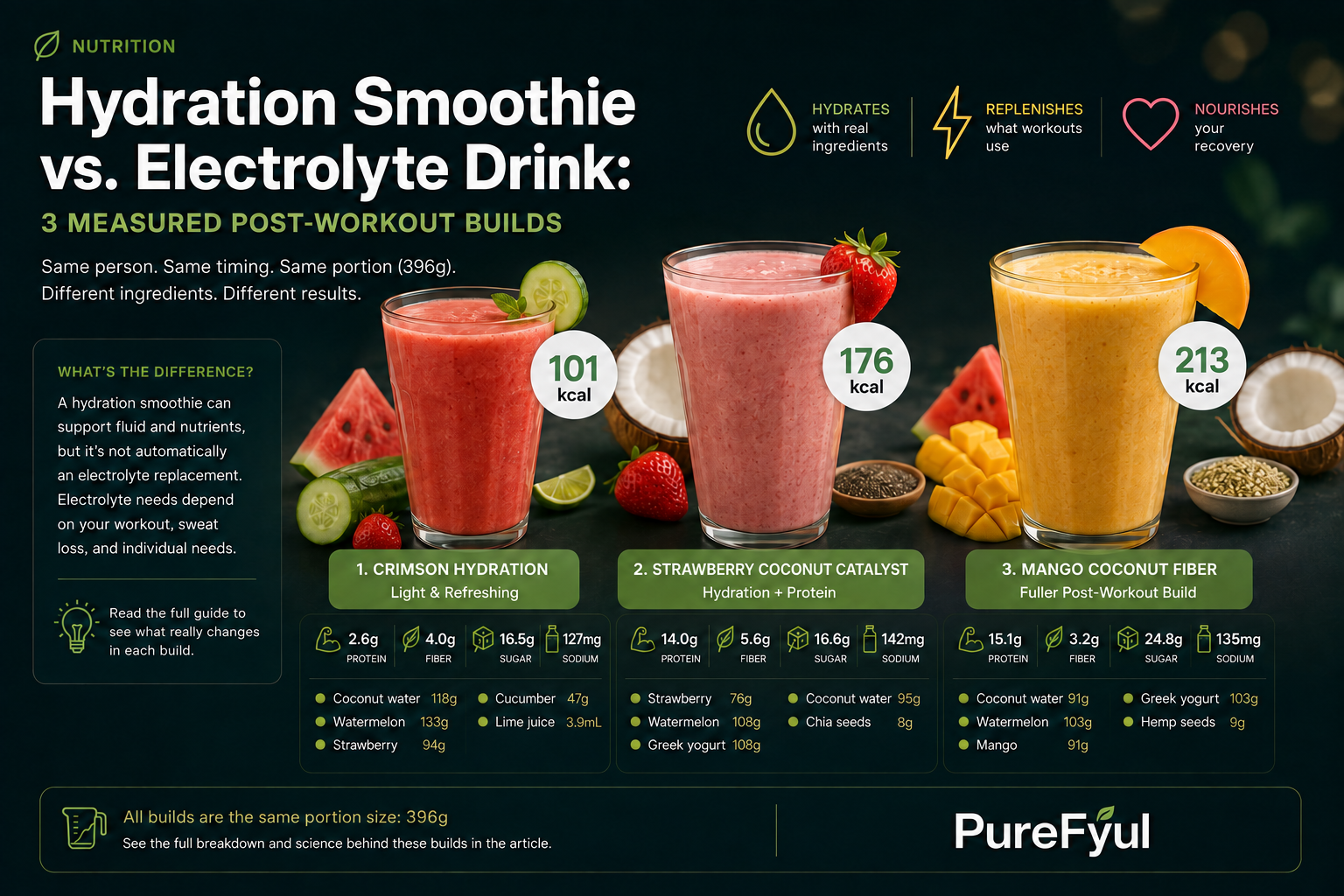
Build 1: Crimson Hydration — The Light Hydration-Focused Smoothie
The first build stays deliberately simple.
Ingredients per 396g portion
- Coconut water — 118g
- Watermelon — 133g
- Strawberry — 94g
- Cucumber — 47g
- Lime juice — 3.9mL
Nutrition per portion
- Calories — 101 kcal
- Protein — 2.6g
- Fiber — 4.0g
- Sugar — 16.5g
- Carbohydrates — 25.1g
- Fat — 0.8g
- Sodium — 127mg
This is the lightest smoothie in the comparison.
There is no yogurt, protein powder, nut butter or concentrated seed serving.
Watermelon, cucumber and coconut water keep the ingredient structure hydration-focused, while strawberry and lime provide more flavor.
PureFyul also found something that is easy to miss by looking at the recipe:
Strawberry makes up 24% of the blend by nutrition weight but contributes 48% of its total fiber.
The smoothie therefore contains 4 grams of fiber even though it remains only 101 calories.
But look at the protein.
At 2.6 grams, Crimson Hydration is clearly not trying to function as a high-protein post-workout meal.
And that is fine.
Not every smoothie needs to perform every nutritional job.
Build 2: Strawberry Coconut Catalyst — Hydration Meets Protein
Now we change the structure without changing the finished portion.
Ingredients per 396g portion
- Strawberry — 76g
- Watermelon — 108g
- Greek yogurt — 108g
- Coconut water — 95g
- Chia seeds — 8g
Nutrition per portion
- Calories — 176 kcal
- Protein — 14.0g
- Fiber — 5.6g
- Sugar — 16.6g
- Carbohydrates — 25.7g
- Fat — 3.4g
- Sodium — 142mg
This is where the comparison gets interesting.
The first smoothie contained 16.5g of sugar.
This one contains 16.6g.
Almost no difference.
But protein jumps from:
2.6g → 14.0g
Calories rise from:
101 → 176
And fiber increases from:
4.0g → 5.6g
Why?
Because we changed the smoothie's architecture instead of simply adding more fruit.
Greek yogurt serves as the protein anchor, while a measured 8 grams of chia seeds add fiber and body.
PureFyul calculated that Greek yogurt represents 27% of the blend’s weight while supplying 77% of its protein.
That is a useful lesson for post-workout smoothie building:
A hydration-focused smoothie does not need to become dramatically sweeter just because you want substantially more protein.
This build still contains watermelon and coconut water, but its nutritional role is clearly different from Crimson Hydration.
It also contains milk, so people with a milk allergy should check product labels and choose an appropriate alternative.
Build 3: Mango Coconut Fiber — The Fuller Post-Workout Build
The third smoothie keeps watermelon and coconut water but moves toward a more substantial post-workout profile.
Ingredients per 396g portion
- Coconut water — 91g
- Watermelon — 103g
- Mango — 91g
- Greek yogurt — 103g
- Hemp seeds — 9g
Nutrition per portion
- Calories — 213 kcal
- Protein — 15.1g
- Fiber — 3.2g
- Sugar — 24.8g
- Carbohydrates — 29.9g
- Fat — 5.6g
- Sodium — 135mg
Protein rises only slightly compared with Build 2:
14.0g → 15.1g
But the rest of the nutrition changes more noticeably.
Sugar increases from 16.6g to 24.8g.
Carbohydrates increase from 25.7g to 29.9g.
Fat increases from 3.4g to 5.6g.
Calories rise from 176 to 213.
This is exactly why ingredient selection matters more than labels such as “healthy,” “hydrating,” or “post-workout.”
Mango changes the carbohydrate and sugar profile, while hemp seeds change the fat contribution.
PureFyul found that hemp seeds make up only 2% of this blend by weight yet contribute 79% of its total fat.
Nine grams does not look like much in a blender.
Nutritionally, it matters.
This build also contains milk through the Greek yogurt.
Three 396g Smoothies. Three Very Different Jobs.
Now compare them directly.
Crimson Hydration
101 kcal · 2.6g protein · 4.0g fiber · 16.5g sugar
Best understood as the lightest, hydration-focused option in this comparison.
Strawberry Coconut Catalyst
176 kcal · 14.0g protein · 5.6g fiber · 16.6g sugar
A stronger middle ground when you want watermelon and coconut water while adding meaningful protein.
Mango Coconut Fiber
213 kcal · 15.1g protein · 3.2g fiber · 24.8g sugar
The most substantial of the three, with more calories, carbohydrates, sugar, and fat.
Notice what did not change:
The finished serving size.
Every smoothie is 396 grams.
The nutrition changed because the ingredients changed.
That is the core idea behind measured smoothie building.
Is Coconut Water an Electrolyte Drink?
Coconut water naturally contains electrolytes, which is why it appears so frequently in post-workout and hydration recipes.
But coconut water is not identical to every formulated sports drink.
Electrolyte needs depend on factors such as:
- Exercise duration
- Exercise intensity
- Heat and humidity
- Individual sweat rate
- How much sodium a person loses in sweat
- Fluid consumed before and during exercise
- Food eaten around the workout
Someone taking a short indoor workout may have very different replacement needs from someone completing a long run in summer heat.
So “contains electrolytes” and “fully replaces what you lost during exercise” are not interchangeable statements.
Does Watermelon Make a Smoothie More Hydrating?
Watermelon provides substantial fluid due to its high water content.
That makes it useful in a hydration-focused smoothie, particularly when paired with another liquid such as coconut water.
But watermelon also contributes carbohydrates and sugar.
The Mango Coconut Fiber build shows why the entire recipe matters: adding different fruits can significantly change sugar and carbohydrate totals even when watermelon and coconut water remain in the smoothie.
Hydration is one characteristic of the recipe.
It should not erase the rest of the nutrition.
Should a Post-Workout Hydration Smoothie Include Protein?
It depends on what you want the smoothie to do.
If the smoothie is simply a light refreshment and you will eat a meal separately, high protein may not be necessary in the drink itself.
If the smoothie is intended to contribute to post-workout nutrition, adding a protein source changes its role considerably.
Our comparison makes that visible.
Crimson Hydration provides 2.6g protein.
Adding Greek yogurt and chia in Strawberry Coconut Catalyst raises protein to 14.0g without meaningfully changing the sugar total.
Mango Coconut Fiber reaches 15.1g protein while also increasing carbohydrates, sugar, calories, and fat.
The correct question, therefore, is not:
“Does my hydration smoothie have protein?”
It is:
“What job do I need this smoothie to perform?”
Is More Sodium Better After a Workout?
Not automatically.
Sodium is an important electrolyte lost through sweat, but individual losses vary considerably.
The three PureFyul builds contain:
- Crimson Hydration — 127mg sodium
- Strawberry Coconut Catalyst — 142mg sodium
- Mango Coconut Fiber — 135mg sodium
Those numbers tell us how much sodium is present in each measured smoothie.
They do not tell us whether that amount replaces the sodium a particular person lost during a workout.
That requires context about the workout and the individual.
This is why we would not market any of these three recipes as a medical rehydration solution or guaranteed electrolyte replacement.
Hydration Smoothie or Electrolyte Drink: Which Should You Choose?
Think about the purpose first.
Choose a lighter hydration-focused smoothie when you mainly want something cold, fruit-based, and refreshing around a relatively ordinary workout.
Choose a protein-supported smoothie when you want the drink to contribute more meaningfully to your post-workout nutrition.
A purpose-formulated electrolyte or sports drink may make more sense when substantial sweat loss and electrolyte replacement are the primary objectives, particularly during longer, harder, or hotter exercise.
And plain water remains an important part of everyday hydration.
There is no rule requiring one drink to do everything.
The Biggest Mistake: Calling Every Coconut-Water Smoothie an Electrolyte Smoothie
This is where nutrition wording gets sloppy.
Add coconut water to a smoothie, and it is easy to write:
“Packed with electrolytes!”
But what does that actually mean?
How much sodium?
How much potassium?
What portion?
How much protein?
How much sugar?
Was the workout twenty minutes indoors or ninety minutes outside in the heat?
Without those answers, the claim sounds more precise than the evidence actually is.
A better approach is:
Build a hydration-focused smoothie, measure the complete portion, review the nutrition you actually know, and avoid pretending the recipe can replace losses you never measured.
That may be less dramatic.
It is much more useful.
The PureFyul Hydration Ladder
These three smoothies show how a single theme can branch into three distinct nutritional outcomes.
Start with:
Watermelon + coconut water
Then decide what the smoothie needs to become.
Keep it light
Add cucumber, strawberry, and lime.
Result:
101 calories and 2.6g protein
Add a protein anchor
Use Greek yogurt with strawberry and measured chia.
Result:
176 calories and 14.0g protein
Make it more substantial
Add mango, Greek yogurt, and hemp seeds.
Result:
213 calories and 15.1g protein
Same audience.
Same timing.
Same health goal.
Same 396g finished portion.
Different ingredients.
Very different nutrition.
That is the point.
Build Your Own Post-Workout Smoothie With the Numbers Visible
“Watermelon smoothie,” “hydration smoothie,” and “electrolyte smoothie” are useful search terms.
They are not complete nutrition plans.
Your ingredients and quantities determine what ends up in the glass.
With PureFyul’s smoothie builder, you can choose your audience, timing, health goal, and ingredients, then review a measured portion with calorie, protein, fiber, sugar, carbohydrate, fat, and sodium counts before blending.
Instead of asking whether a smoothie sounds hydrating or balanced, check what you actually built.
Build your post-workout smoothie with PureFyul.
Sources
- American College of Sports Medicine: Hydration & Electrolytes
- National Athletic Trainers' Association: Fluid Replacement for the Physically Active
- FDA: How to Understand and Use the Nutrition Facts Label
- PubMed: Coconut Water as a Rehydration Beverage
PureFyul nutrition values are estimates based on the ingredients and portions generated by the platform. Ingredient brands, varieties and preparation methods can change nutrition values. This article is for general educational purposes and is not medical, sports-medicine or individualized nutrition advice.