Fibermaxxing is one of 2026’s biggest nutrition trends. Google reported that searches for dietary fiber reached an all-time high, while searches for “fibermaxxing” increased 115% over 90 days.
The basic idea is useful: eat more fiber-rich foods.
The execution is where many fibermaxxing smoothies go wrong.
Fruit, oats, chia seeds, flaxseed, dates, nut butter and protein powder can all sound healthy individually. But throwing several full portions into one blender can create an oversized smoothie without a clear serving size or nutritional purpose.
A smarter fibermaxxing smoothie gives every ingredient a job.
This guide uses three PureFyul-verified, 360-gram breakfast portions to show how measured ingredients can deliver meaningful fiber without turning the blender into an ingredient pile-up.
The PureFyul Sample Profile
All three smoothie builds were generated using the same PureFyul settings:
- Audience: Woman aged 19–30
- Timing: Breakfast
- Health goal: Digestive Support
- Built portion: 360 grams
The quantities and nutrition values below are shown per 360-gram serving, not for an undefined blender batch.
Nutrition requirements vary between individuals. These examples demonstrate how PureFyul calculates a specific profile and portion; they are not universal meal prescriptions.
What Is a Fibermaxxing Smoothie?
Fibermaxxing means intentionally adding more fiber-rich foods to your daily diet.
In a smoothie, fiber may come from ingredients such as:
- Berries
- Kiwi
- Oats
- Chia seeds
- Flaxseed
- Other whole fruits, vegetables, seeds and grains
The goal should not be to produce the highest fiber number possible.
A more useful goal is to build a high-fiber smoothie that also has:
- A defined portion
- A measured fiber source
- A protein anchor
- Enough liquid for the desired texture
- Nutrition numbers you can review before blending
That is the difference between fiber-focused building and random ingredient stacking.
How Much Fiber Counts as High Fiber?
The FDA lists 28 grams of dietary fiber as the Daily Value based on a 2,000-calorie diet.
The FDA’s general label guidance considers 20% of the Daily Value or more per serving to be high in a nutrient.
For fiber, that benchmark is approximately 5.6 grams per serving.
All three PureFyul smoothie examples in this guide exceed that benchmark:
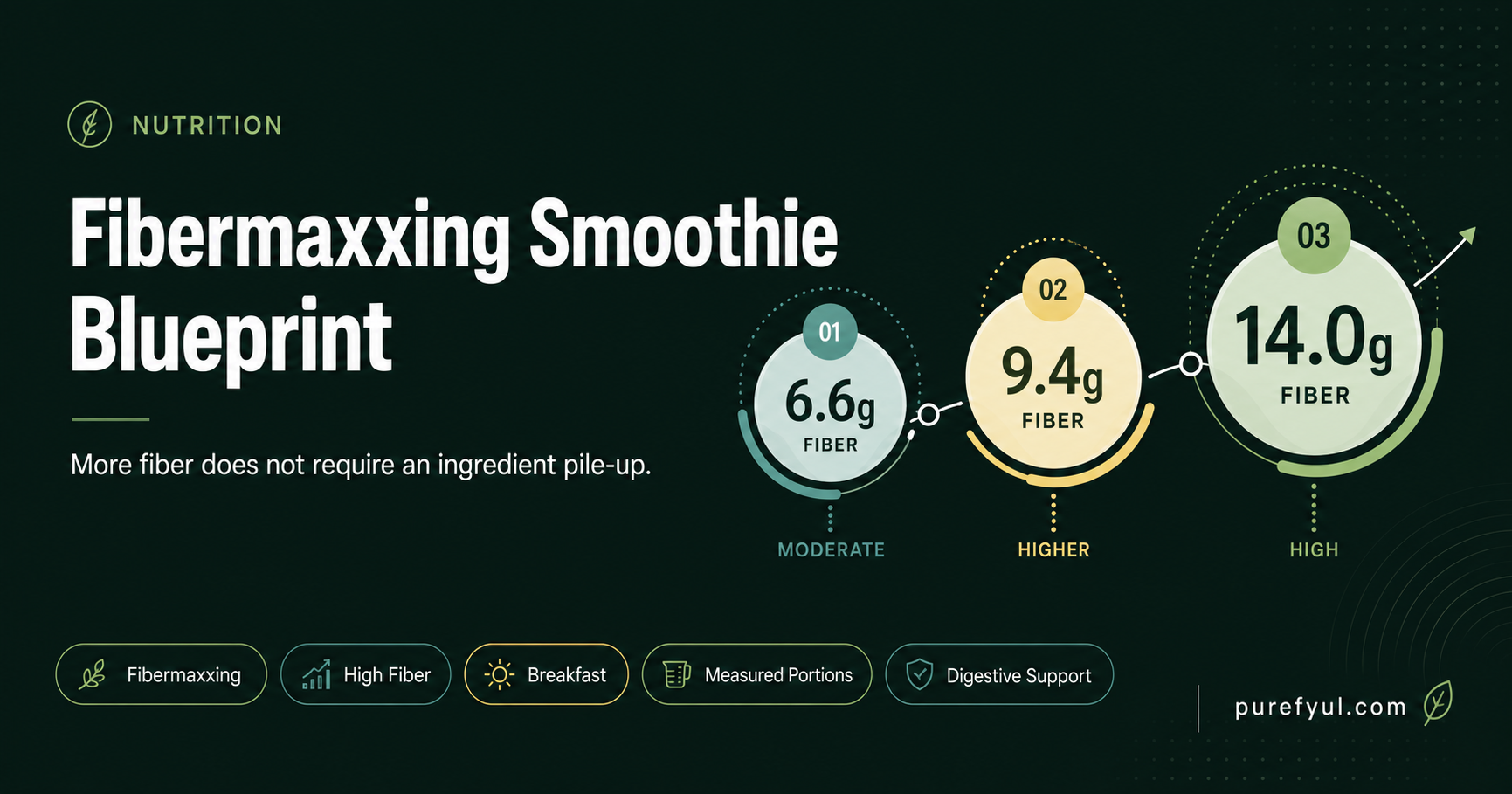
- Kiwi–Blueberry Oat Build: 6.6g fiber
- Raspberry–Chia Fiber Anchor: 9.4g fiber
- Blackberry–Kiwi Plant Build: 14.0g fiber
That does not mean every person needs the highest-fiber option. It means a smoothie can reach a meaningful fiber level without trying to squeeze an entire day’s fiber into one glass.
The No-Pile-Up Fibermaxxing Blueprint
A measured fibermaxxing smoothie can be organized into four ingredient roles.
1. Produce Base
Choose one or two whole fruits that provide flavor, volume and naturally occurring fiber.
2. Primary Fiber Booster
Choose one measured ingredient such as oats, chia seeds or flaxseed to strengthen the fiber content.
A second booster may be included when it has a clear purpose, but it should not be added automatically.
3. Protein Anchor
Use an ingredient such as Greek yogurt or fortified soy milk to stop the smoothie from becoming only fruit, seeds and liquid.
4. Portion-Controlled Liquid
Use enough liquid to create the desired consistency while keeping the finished portion defined.
The three smoothies below show how this blueprint changes when the ingredients and fiber targets change.
Smoothie 1: Kiwi–Blueberry Oat Fiber Start
This is the lowest-fiber option of the three verified builds, but it still provides more than the FDA’s general 20% Daily Value benchmark.
Ingredients per 360g serving
- Kiwi — 62g
- Blueberry — 74g
- Oats — 25g
- Greek yogurt — 106g
- Unsweetened almond milk — 93mL
Nutrition per serving
- Calories — 253 kcal
- Protein — 16.5g
- Fiber — 6.6g
- Total sugar — 17.3g
- Carbohydrates — 40.9g
- Fat — 3.8g
- Sodium — 108mg
Why this build works
Kiwi and blueberry create the produce base.
Oats serve as the main concentrated fiber booster, while Greek yogurt provides the protein anchor. Unsweetened almond milk supplies the blending liquid without adding another fruit or sweetener.
PureFyul’s ingredient analysis found that oats make up only 7% of the blend by nutrition weight but contribute 42% of its total fiber.
That is exactly why measured nutrition matters. The visually smallest ingredient can have a disproportionately large effect on the final result.
At 6.6 grams, this smoothie provides approximately 24% of the FDA Daily Value for fiber.
This is the most moderate fiber starting point among the three examples.
Smoothie 2: Raspberry–Chia Fiber Anchor
This build delivers more fiber and slightly more protein than the first smoothie while containing fewer calories and less total sugar.
Ingredients per 360g serving
- Raspberry — 76g
- Strawberry — 76g
- Chia seeds — 8g
- Greek yogurt — 107g
- Unsweetened fortified soy milk — 94mL
Nutrition per serving
- Calories — 200 kcal
- Protein — 16.6g
- Fiber — 9.4g
- Total sugar — 12.0g
- Carbohydrates — 24.0g
- Fat — 5.4g
- Sodium — 84mg
Why this build works
Raspberry and strawberry form a two-fruit produce base.
Chia seeds are the measured fiber booster. Greek yogurt and fortified soy milk create a stronger protein foundation without requiring protein powder.
PureFyul calculated that raspberry represents 21% of the blend by nutrition weight while delivering 52% of the smoothie’s total fiber.
This result exposes a common smoothie-building mistake: judging ingredients by how much space they occupy instead of what they contribute nutritionally.
At 9.4 grams, this smoothie provides approximately 34% of the FDA Daily Value for fiber.
Among these three examples, it also has:
- The lowest calorie total
- The highest protein total, although only narrowly
- The lowest total sugar
- The second-highest fiber total
This build contains milk and soy ingredients. Always check product labels when managing food allergies.
Smoothie 3: Blackberry–Kiwi Plant Fiber Build
This plant-based smoothie delivers the highest fiber amount of the three verified examples.
It also shows why “highest fiber” should not automatically be treated as “best for everyone.”
Ingredients per 360g serving
- Blackberry — 104g
- Kiwi — 86g
- Oats — 35g
- Flaxseed — 6g
- Unsweetened fortified soy milk — 129mL
Nutrition per serving
- Calories — 314 kcal
- Protein — 13.8g
- Fiber — 14.0g
- Total sugar — 14.8g
- Carbohydrates — 50.2g
- Fat — 8.5g
- Sodium — 64mg
Why this build works
Blackberry and kiwi create the produce base.
Flaxseed acts as the concentrated seed booster, while oats provide additional whole-grain fiber and body. Fortified soy milk functions as both the liquid and the plant-based protein anchor.
At 14 grams, this smoothie provides 50% of the FDA Daily Value for fiber.
That is a substantial amount for one serving, especially for someone whose usual diet is relatively low in fiber.
PureFyul also found that although kiwi represents only 24% of the blend by weight, it contributes 52% of the smoothie’s total sugar.
This does not make kiwi a bad ingredient. It demonstrates why ingredient reputation alone cannot describe the complete smoothie.
The same build can be:
- High in fiber
- Plant-based
- Moderate in total sugar
- Higher in calories and carbohydrates than another high-fiber option
This build contains soy.
Which Fibermaxxing Smoothie Fits Which Situation?
These recipes should not be ranked only by their fiber totals.
Choose the Kiwi–Blueberry Oat Build when:
- You want the most moderate fiber option of the three
- You prefer oats as the main booster
- You want a dairy-based protein anchor
- You do not want chia seeds or flaxseed
Choose the Raspberry–Chia Fiber Anchor when:
- You want the lowest-calorie option of the three
- You want more than 9 grams of fiber
- You want approximately 16.6 grams of protein
- You prefer berries and chia seeds
- You are comfortable with milk and soy ingredients
Choose the Blackberry–Kiwi Plant Build when:
- You want a completely plant-based ingredient combination
- You want the highest-fiber option
- You already tolerate higher-fiber meals comfortably
- You want oats and flaxseed in the same measured build
- You are comfortable with soy ingredients
The highest-fiber smoothie is not automatically the correct starting point.
The useful choice depends on your normal fiber intake, dietary preferences, calorie needs, allergies and the rest of your day’s meals.
Five Fibermaxxing Smoothie Mistakes
1. Treating 28 Grams as a Per-Smoothie Requirement
The FDA’s 28-gram figure is a Daily Value reference, not a requirement for every breakfast smoothie.
Fiber can come from meals and snacks throughout the day.
2. Adding Several Full-Sized Boosters
Oats, chia seeds, flaxseed and nut butter can each change the nutrition result significantly.
Adding all of them without measuring is not a blueprint. It is guesswork.
3. Ignoring the Finished Portion
A blender may hold several servings even when the recipe is described as one smoothie.
Every example in this guide uses a defined 360-gram portion, so the nutrition values correspond to an actual serving.
4. Looking at Fiber Alone
The three smoothies contain between 6.6 and 14 grams of fiber, but their calories, protein, sugar, carbohydrates and fat are different.
A useful smoothie decision considers the complete result.
5. Increasing Fiber Too Quickly
A sudden increase in fiber may cause gas, bloating, cramping or digestive discomfort for some people.
Increase fiber gradually and drink adequate fluids. People with digestive conditions, medically prescribed diets or persistent symptoms should speak with a qualified healthcare professional.
Is 6 Grams of Fiber in a Smoothie Considered High?
Using the FDA’s general 20% Daily Value benchmark, approximately 5.6 grams of fiber per serving reaches the high range.
The Kiwi–Blueberry Oat Build contains 6.6 grams, so it passes that benchmark without reaching the much higher 14-gram level of the plant-based build.
Is a 14-Gram Fiber Smoothie Too Much?
There is no single answer for every person.
Fourteen grams equals half of the FDA’s 28-gram Daily Value. Someone who regularly eats a fiber-rich diet may respond differently from someone whose normal intake is low.
The sensible approach is not to chase the highest number. It is to increase fiber gradually and observe how your body responds.
What Is the Best Fiber Booster for a Smoothie?
There is no universally best booster.
In these three PureFyul builds:
- Oats provide the primary boost in the Kiwi–Blueberry smoothie
- Chia seeds strengthen the Raspberry–Strawberry smoothie
- Flaxseed and oats work together in the Blackberry–Kiwi smoothie
These are complete recipes with different fruit, liquid and protein combinations. They should not be treated as a controlled comparison proving that one booster is superior to another.
The better booster is the one that fits your portion, nutrition target, allergies, preferred texture and digestive tolerance.
Fibermaxxing Should Be Measured, Not Maximized
The strongest lesson from these three builds is not that every smoothie needs 14 grams of fiber.
It is that measured combinations produce very different outcomes:
- 6.6g fiber at 253 calories
- 9.4g fiber at 200 calories
- 14.0g fiber at 314 calories
All three are 360-gram breakfast portions generated for the same audience, timing and health goal.
Changing the fruit, booster, protein anchor and liquid changed the entire nutrition result.
That is why fibermaxxing works better as a blueprint than an ingredient competition.
Build Your Own High-Fiber Smoothie
A handful, scoop or spoonful does not tell you the complete nutrition result.
With PureFyul’s smoothie builder, you can select your profile, timing, health goal and ingredients to receive measured quantities for your portion.
You can then review calories, protein, fiber, sugar, carbohydrates, fat and sodium before blending.
Build your fibermaxxing smoothie with PureFyul.
Sources
- Google Trends: What’s trending on Google this summer
- FDA: Daily Value on the Nutrition and Supplement Facts Labels
- FDA: The Lows and Highs of Percent Daily Value
- Mayo Clinic: Why is fiber good for your overall health?
PureFyul nutrition values are estimates based on the ingredients and portions entered into the platform. Values may vary by ingredient variety, product brand and preparation method. This article is for general educational purposes and is not medical or individualized nutrition advice.