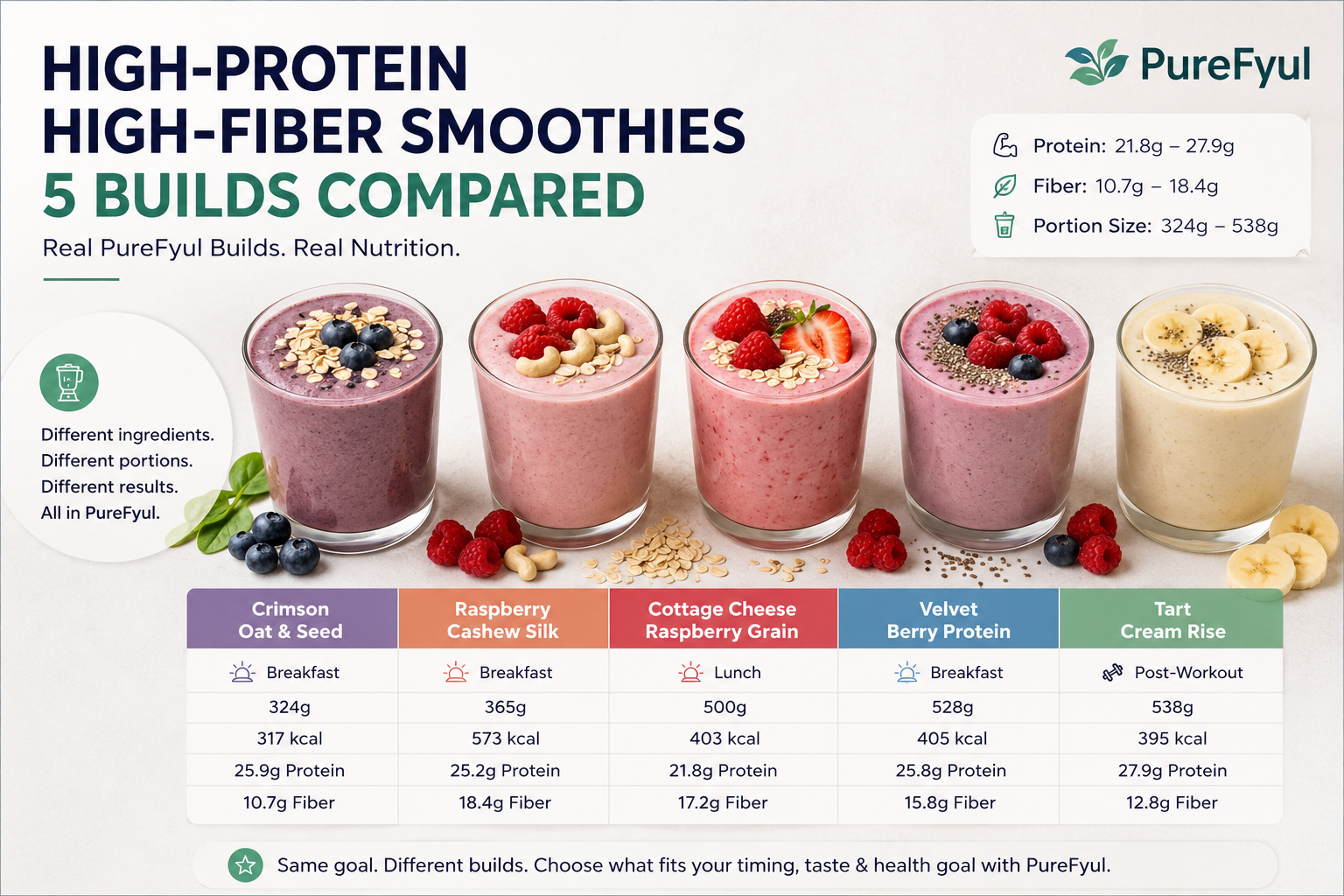
A high-protein, high-fiber smoothie is not one fixed recipe.
Two smoothies can contain almost the same amount of protein while having very different portion sizes, calories, fiber and ingredient combinations.
We compared five smoothie builds created in PureFyul using different audience, timing and health-goal selections.
The resulting portions ranged from 324g to 538g, while protein ranged from 21.8g to 27.9g and fiber ranged from 10.7g to 18.4g.
That difference is worth looking at because a larger smoothie does not automatically mean more protein, and adding more nuts or seeds does not automatically produce a better protein-to-calorie result.
5 High-Protein, High-Fiber Smoothies Compared Smoothie Timing Portion Calories Protein Fiber Crimson Oat & Seed Breakfast 324g 317 kcal 25.9g 10.7g Raspberry Cashew Silk Breakfast 365g 573 kcal 25.2g 18.4g Cottage Cheese Raspberry Grain Lunch 500g 403 kcal 21.8g 17.2g Velvet Berry Protein Breakfast 528g 405 kcal 25.8g 15.8g Tart Cream Rise Post-Workout 538g 395 kcal 27.9g 12.8g
These are not five versions of the same smoothie.
Each build uses a different ingredient combination and was generated from a different PureFyul setup.
That makes the comparison useful: similar protein numbers can come from very different portions and nutrition profiles.
- Crimson Oat & Seed
Timing: Breakfast Health goal: Digestive Support Audience: Woman 31–59 Built portion: 324g
Ingredients Greek yogurt — 112g Raspberry — 79g Oats — 26g Chia seeds — 8g Pea milk — 99mL Nutrition 317 calories 25.9g protein 10.7g fiber 34.2g carbohydrates 9.7g fat 7.8g sugar 161mg sodium
This was the smallest portion and lowest-calorie smoothie in the five-build comparison.
It still contained 25.9g protein, which was nearly identical to the protein in the much larger Velvet Berry Protein build.
PureFyul also calculated that raspberries made up about 24% of this blend by nutrition weight while contributing 48% of its total fiber.
That shows why ingredient contribution matters more than simply counting how many ingredients are in the blender.
- Raspberry Cashew Silk
Timing: Breakfast Health goal: Heart Support Audience: Man 31–59 Built portion: 365g
Ingredients Fortified unsweetened soy milk — 150mL Raspberry — 120g Oats — 40g Cashews — 28g Hemp seeds — 15g Chia seeds — 12g Nutrition 573 calories 25.2g protein 18.4g fiber 58.5g carbohydrates 30.0g fat 9.4g sugar 76mg sodium
At 18.4g, this build contained the most fiber of the five smoothies.
It was also the highest-calorie build.
PureFyul's ingredient analysis showed that cashews represented only about 8% of the blend by nutrition weight but contributed 41% of its total fat.
That is an important reminder when building a protein-and-fiber smoothie.
Nuts, seeds, oats and other nutrient-dense ingredients can affect several nutrition numbers at the same time. Looking only at whether an ingredient sounds healthy does not tell you what the finished smoothie contains.
- Cottage Cheese Raspberry Grain
Timing: Lunch Health goal: Bone Strength Audience: Woman 19–30 Built portion: 500g
Ingredients Cottage cheese — 100g Raspberry — 109g Strawberry — 109g Oats — 36g Chia seeds — 11g Almond milk — 136mL Nutrition 403 calories 21.8g protein 17.2g fiber 55.0g carbohydrates 12.6g fat 12.7g sugar 465mg sodium
This smoothie contains both protein and fiber without protein powder.
Cottage cheese did most of the protein work.
PureFyul calculated that cottage cheese represented about 20% of the blend by nutrition weight while contributing 50% of its total protein.
Raspberries, chia seeds and oats contributed to the fiber side of the build.
This is a useful example of an important smoothie-building principle:
The main protein ingredient and the main fiber ingredients do not have to be the same food.
If you want to see how cottage cheese changes smoothie protein at different amounts, read Cottage Cheese Smoothie Protein Math.
- Velvet Berry Protein
Timing: Breakfast Health goal: Energy & Stamina Audience: Man 31–59 Built portion: 528g
Ingredients Greek yogurt — 164g Blueberry — 99g Raspberry — 99g Oats — 33g Chia seeds — 10g Coconut milk — 123mL Nutrition 405 calories 25.8g protein 15.8g fiber 60.0g carbohydrates 8.9g fat 22.7g sugar 82mg sodium
Greek yogurt was the major protein contributor in this build.
According to PureFyul's ingredient analysis, Greek yogurt represented about 31% of the blend by nutrition weight while contributing 64% of its total protein.
Now compare this smoothie with Crimson Oat & Seed:
Velvet Berry Protein
528g portion 25.8g protein
Crimson Oat & Seed
324g portion 25.9g protein
The difference in portion size is 204g, yet their protein totals are almost identical.
A bigger smoothie does not automatically mean a higher-protein smoothie.
The ingredient combination and amounts matter.
- Tart Cream Rise
Timing: Post-Workout Health goal: Muscle Recovery Audience: Man 19–30 Built portion: 538g
Ingredients Greek yogurt — 134g Cottage cheese — 87g Raspberry — 95g Banana — 95g Chia seeds — 9g Oat milk — 118mL Nutrition 395 calories 27.9g protein 12.8g fiber 52.5g carbohydrates 9.7g fat 24.7g sugar 417mg sodium
At 27.9g, this was the highest-protein smoothie in the comparison.
Greek yogurt and cottage cheese provide two major protein sources, while raspberries and chia seeds contribute fiber.
PureFyul calculated that Greek yogurt made up about 25% of the blend by nutrition weight but contributed 48% of its total protein.
There is another useful comparison here.
Tart Cream Rise
395 calories 27.9g protein
Raspberry Cashew Silk
573 calories 25.2g protein
The higher-calorie smoothie did not contain more protein.
Calories, protein and fiber can move differently depending on which ingredients are used.
Which Smoothie Had the Most Protein?
Among these five PureFyul builds, Tart Cream Rise had the most protein at 27.9g.
The full ranking was:
Tart Cream Rise — 27.9g Crimson Oat & Seed — 25.9g Velvet Berry Protein — 25.8g Raspberry Cashew Silk — 25.2g Cottage Cheese Raspberry Grain — 21.8g
The difference between the highest and lowest was about 6g.
The calorie difference across the same five smoothies was much larger: 317 to 573 calories.
That is why protein should not be judged in isolation.
Which Smoothie Had the Most Fiber?
Raspberry Cashew Silk had the highest fiber total at 18.4g.
It was followed by:
Raspberry Cashew Silk — 18.4g Cottage Cheese Raspberry Grain — 17.2g Velvet Berry Protein — 15.8g Tart Cream Rise — 12.8g Crimson Oat & Seed — 10.7g
Raspberries, chia seeds and oats appeared repeatedly across these builds.
However, their amounts changed from smoothie to smoothie, which changed the final fiber totals.
Can You Make a High-Protein, High-Fiber Smoothie Without Protein Powder?
Yes.
None of the five smoothies in this comparison used protein powder.
Protein came from combinations including:
Greek yogurt cottage cheese soy milk pea milk hemp seeds nuts and seeds
Fiber came largely from ingredients including:
raspberries chia seeds oats other berries
Protein powder can be one way to add protein, but it is not the only way to build a smoothie containing both protein and fiber.
Does a Bigger Smoothie Have More Protein?
Not necessarily.
The clearest example from these five builds is:
324g Crimson Oat & Seed: 25.9g protein
528g Velvet Berry Protein: 25.8g protein
The larger smoothie weighs more than 200g extra but contains almost exactly the same amount of protein.
Portion size tells you how much smoothie is in the serving.
It does not tell you where the calories, protein, fiber or other nutrients came from.
Why Can Two Smoothies With Similar Protein Have Very Different Calories?
Compare:
Crimson Oat & Seed
25.9g protein 317 calories
with:
Raspberry Cashew Silk
25.2g protein 573 calories
Their protein differs by less than 1g.
Their calories differ by 256 calories.
The reason is the rest of the ingredient composition.
The Raspberry Cashew Silk contains ingredients such as cashews, hemp seeds, chia seeds and oats. Those ingredients contribute more than protein alone.
This is why looking only at a smoothie's protein number can miss much of its nutrition profile.
Protein Ingredients and Fiber Ingredients Do Different Jobs
It is easy to search for a single ingredient that provides everything.
These five examples show a different pattern.
For protein, important contributors included:
Greek yogurt cottage cheese soy milk pea milk hemp seeds
For fiber, recurring contributors included:
raspberries chia seeds oats blueberries and strawberries
Some ingredients contribute to both categories, but they do not necessarily contribute equal amounts of each.
A useful smoothie can therefore be built by combining ingredients with different jobs rather than expecting one ingredient to provide everything.
How Much Smoothie Should You Make?
There was no single serving size across these five builds.
PureFyul returned portions ranging from:
324g to 538g
because the examples used different audience, timing and health-goal selections.
These portions should not be interpreted as universal prescriptions for every person.
They show the measurable result of each specific PureFyul setup.
That allows the finished smoothie to be evaluated by its actual ingredients, portion size and nutrition rather than assuming every breakfast, lunch or post-workout smoothie should be identical.
Build Your Own Protein + Fiber Smoothie
Changing even one ingredient can change the final nutrition.
Replacing the milk, increasing berries, changing the amount of Greek yogurt, adding oats or changing the amount of chia can affect:
portion size calories protein fiber carbohydrates fat sugar sodium
PureFyul shows those numbers for the smoothie it builds instead of asking you to judge the result from the ingredient names alone.
Build your smoothie in PureFyul.
Frequently Asked Questions What can I add to a smoothie for protein and fiber?
In these builds, protein came largely from ingredients such as Greek yogurt, cottage cheese, soy milk and pea milk. Fiber came largely from raspberries, chia seeds and oats.
The final numbers depend on the ingredient amounts.
Can I make a high-protein, high-fiber smoothie without protein powder?
Yes. All five PureFyul builds in this comparison were made without protein powder.
They contained between 21.8g and 27.9g protein and between 10.7g and 18.4g fiber.
Does Greek yogurt add fiber?
Greek yogurt is primarily a protein contributor in these examples. The fiber came from ingredients such as berries, oats and chia seeds.
What berries can add fiber to a smoothie?
Raspberries appeared in all five builds and made a substantial fiber contribution in several of them. Blueberries and strawberries also appeared in individual builds.
The amount used matters when calculating the final fiber total.
Are chia seeds good for protein or fiber?
Chia seeds contribute both protein and fiber, but in these smoothie combinations their most important role was generally on the fiber side.
Which smoothie in this comparison had the best protein-to-calorie result?
Crimson Oat & Seed contained 25.9g protein at 317 calories, the highest protein relative to calories among these five builds.
That does not mean it is automatically the best smoothie for every person or situation. It simply describes this particular comparison.
Are these personalized daily protein or fiber recommendations?
No.
The nutrition values describe what was present in these specific PureFyul builds. They are not prescriptions for an individual's total daily protein, fiber or calorie requirements.
What These Five Smoothies Show
Across the five builds, PureFyul returned:
324–538g portions 317–573 calories 21.8–27.9g protein 10.7–18.4g fiber
The biggest lesson is not that one smoothie is universally better than another.
It is that ingredient choice, ingredient amount and finished portion change the nutrition substantially.
Two smoothies can contain almost identical protein but differ greatly in calories, fiber and serving size.
That is information worth measuring before judging a smoothie from its ingredient list alone.
Try the PureFyul smoothie builder.
Nutrition values shown are the PureFyul outputs for the exact builds used in this comparison. Values may change when ingredient products or quantities change.